
Arrest History in Orange County
Orange County arrest records begin with the agency that takes action. The Orange County Sheriff’s Office handles calls, investigations, traffic and drug enforcement, and warrant service in its jurisdiction. The Town of Orange Police Department and Gordonsville Police Department keep reports for their own officers. Virginia State Police, Virginia Department of Wildlife Resources conservation police, and a lead agency in the Blue Ridge Narcotics Task Force may also create a local arrest report. A request sent to the sheriff does not compel a town or state agency to release a record it created.
Custody adds a distinct file. Orange County has no standalone county jail, and local detainees use Central Virginia Regional Jail. The jail’s intake data may show a booking date, initial charge, bond, and custody status. A magistrate or court then creates warrant, bail, and case events. Qualifying fingerprints and charge data also enter the Virginia Department of State Police Central Criminal Records Exchange, or CCRE, chain. Each file serves a different purpose. None should be treated as a complete Orange County arrest history by itself.
Orange County Arrest Agency Routes
Town lines matter when seeking an Orange County arrest report. A deputy’s report belongs with the Orange County Sheriff’s Office. An Orange police report remains with the town department even if the person later enters the regional jail. Gordonsville routes police records through its Town Clerk and FOIA Officer. A state trooper’s report remains with VSP. The jail can confirm custody, but its booking file cannot replace an officer’s account of the event.
The official Orange County sheriff staff directory identifies the local records contact.

That directory helps a requester reach the Records Clerk and Crime Analyst instead of sending an arrest-record question to the court or jail.
How to Look Up Orange County Arrests
No verified Orange County public booking database covers every recent arrest. A thorough lookup uses a short chain based on the arresting agency, custody stage, and court level. Keep the full name, an approximate date, location, and report or case number close at hand. Use those details to narrow each inquiry and to avoid mixing people who share a name.
- Identify the arresting agency from the location, paperwork, or court entry. Ask that agency for its incident or arrest report. For an Orange County sheriff event, use the agency’s mail, fax, email, counter, or telephone FOIA channels.
- For recent custody, call Central Virginia Regional Jail at (540) 672-3222. Ask about current status with a full name and approximate booking date. A release or transfer can make a current-custody inquiry come back empty.
- Search the General District Court Case Information system for misdemeanors, arraignments, and early felony proceedings. After indictment, search Orange Circuit Court through OCIS. Contact the correct clerk for older files, certified copies, or entries that do not appear online.
- Use the VSP CATS process when a consent-based statewide CCRE record is needed. CATS generates an SP-167 request to print and mail; it is not an instant public name database.
- When an online or phone check fails, submit a narrow records request to the originating agency, call its records contact, or visit its counter. Then compare the agency result with jail, court, and CCRE records as needed.
The full filed charge, docket events, and final result are best read in the Orange County criminal court case record, not inferred from a booking entry.
Note: The Orange County sheriff’s main address and telephone operate continuously, but the research did not verify separate records-counter hours.
Requesting Orange County Arrest Reports
The Orange County Sheriff’s Office accepts requests by U.S. mail, fax, email, in person, or telephone. Virginia FOIA does not require a special form, a written request, or the word “FOIA.” A clear written request is still useful because it fixes the date range, place, event type, report number, arresting unit, record categories, and delivery choice. Ask for existing records. The sheriff need not answer broad questions or create a new report about a person.
The Orange County sheriff Freedom of Information Act page lays out those request routes and identifies the agency’s own FOIA contact.
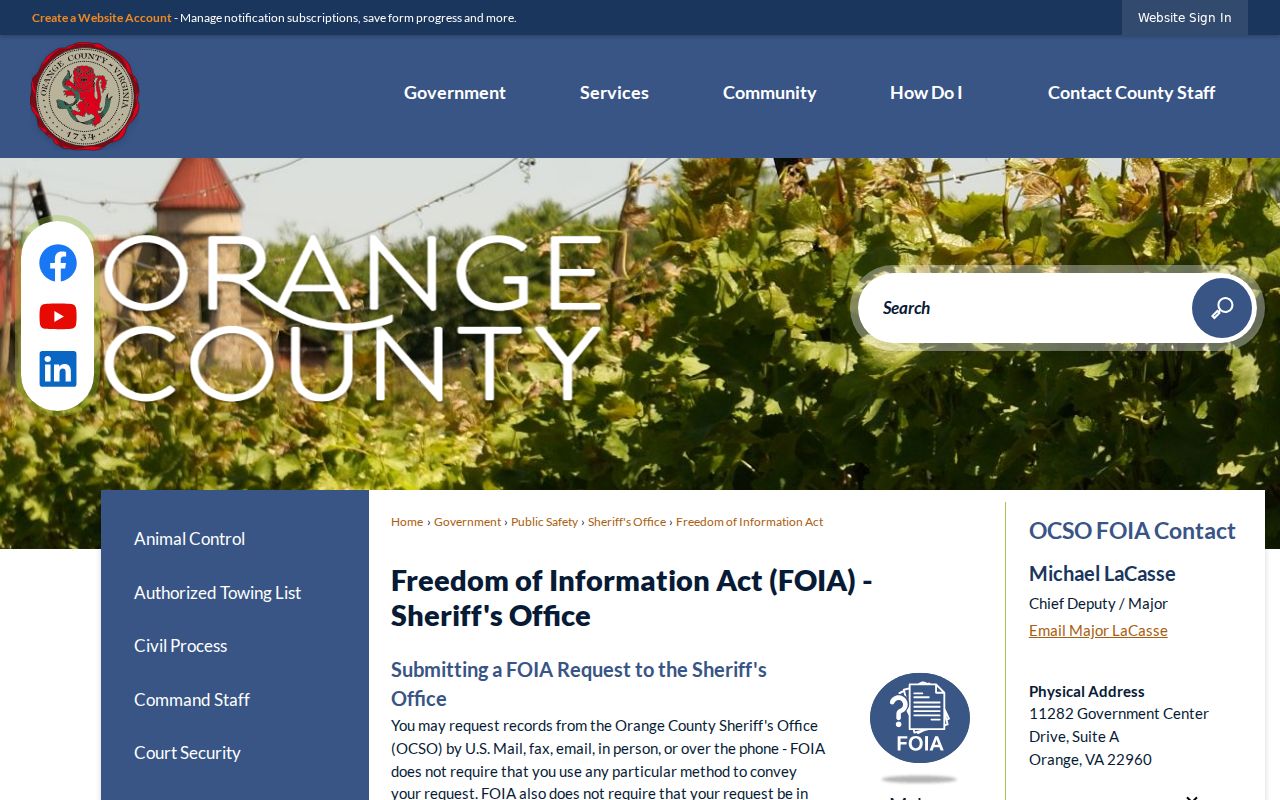
The agency may charge its reasonable actual cost for access, search, supplies, and duplication. A requester can ask for an advance estimate before work begins.
Orange County Sheriff’s Office
Records Clerk/Crime Analyst
11282 Government Center Drive, Suite A
Orange, VA 22960
Main: (540) 672-1200
Records: (540) 672-7204
Fax: (540) 672-7824
What an Arrest Record Shows
An Orange County arrest file is not one standard packet. The agency report can describe probable cause and the alleged event. The regional booking record focuses on intake and custody. The court file records charges that were actually filed and how they ended. A targeted request should name the fields and documents needed, since each custodian controls only its own part.
| Report or booking number | Links the agency event or jail intake to the custodian’s file. |
|---|---|
| Date, time, and location | Shows when and where the arrest or summons occurred and helps narrow a request. |
| Arresting agency | Identifies the sheriff, town police, state agency, or other unit that created the report. |
| Alleged offense | Lists the charge description or Virginia Code section recorded at arrest, which may later change. |
| Warrant or arrest basis | May identify a warrant, capias, summons, or warrantless-arrest basis where releasable. |
| Narrative and supplements | May describe probable cause, witnesses, evidence, and later work, subject to exemptions and redaction. |
| Booking and custody | Can add intake time, fingerprints, photograph, facility, initial charge, bond, and release or transfer status. |
| Court result | Belongs to the clerk’s file and can show the filed charge, hearings, disposition, sentence, and costs. |
Juvenile facts, victim information, personal identifiers, sealed material, and protected investigative details may be withheld or redacted. Virginia Code §2.2-3706 governs public adult arrestee facts, requested booking photos, and law-enforcement records while preserving a felony-investigation jeopardy exception. Virginia law generally calls for releasable parts to be separated when only part of a record is exempt.
Orange County Arrest Charges Can Change
The charge entered at booking reflects the intake basis. It is not a promise that the Commonwealth’s Attorney will file the same charge. A misdemeanor or early felony event may first appear in Orange General District Court. If a felony moves through the preliminary and grand-jury path, the indictment and later judgment belong in Orange Circuit Court. The prosecution can amend, discontinue, or dismiss a charge, and a court can acquit.
The county’s general FOIA guidance shows why the right custodian and a specific request matter.
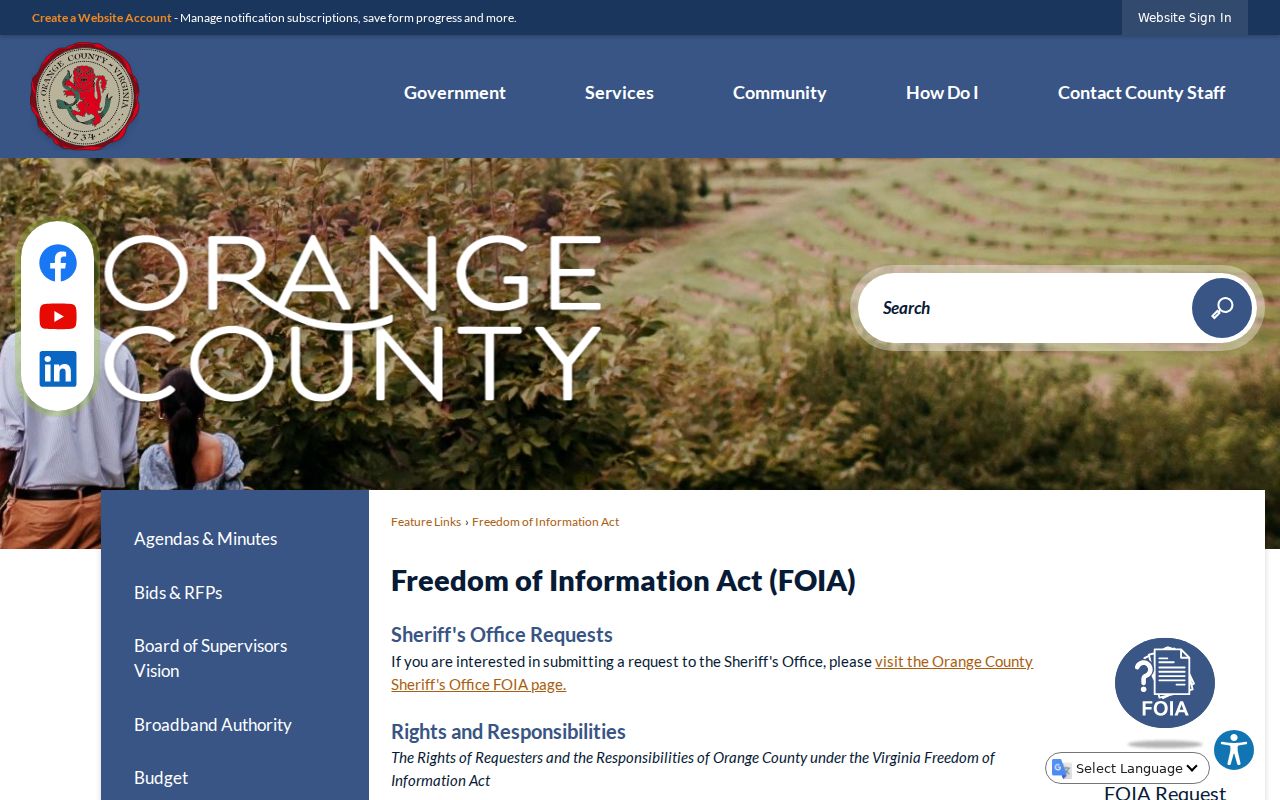
A broad county request cannot substitute for a request to the sheriff, town police, state agency, jail, or court that holds the desired arrest record.
Recent Arrests and Booking Logs
No official Orange County sheriff daily booking report, public arrest blotter, website inmate lookup, or agency app was verified. Town police sites also offered no booking app. Official press releases may describe selected events, but they are not a complete Orange County arrest history. Commercial rosters and mugshot pages are not valid substitutes for an official source.
For a recent detainee, call Central Virginia Regional Jail. Current custody is only one moment in time. A person may have been released on bond or recognizance, transferred to VADOC or another facility, completed a short sentence, or not yet appeared in a system. For state custody or VADOC supervision, use the official VADOC Inmate and Supervisee Locator. It updates daily but warns that data may lag or be inaccurate.
The Orange County Sheriff’s Office Patrol Division page confirms local patrol, investigation, enforcement, and warrant-service roles.

The division’s role explains where a deputy-created incident or arrest report begins, while the jail and courts hold later parts of the record trail.
Orange County Booking to Court
An Orange County custodial case moves across systems in stages. Law enforcement first creates an incident or arrest record. The regional intake process records identity, property, required fingerprints and photograph, the booking charge, and screening data. A magistrate creates bail or detention paperwork. Orange General District Court then handles public first events for misdemeanors and preliminary felony work. A supported felony can later move to Circuit Court for indictment, judgment, and sentence.
Record flow: Arresting agency → Central Virginia Regional Jail → magistrate → General District Court → Circuit Court when indicted → CCRE disposition reporting.
The official Orange County Sheriff’s Office Civil Process page helps separate civil process from criminal custody terms.
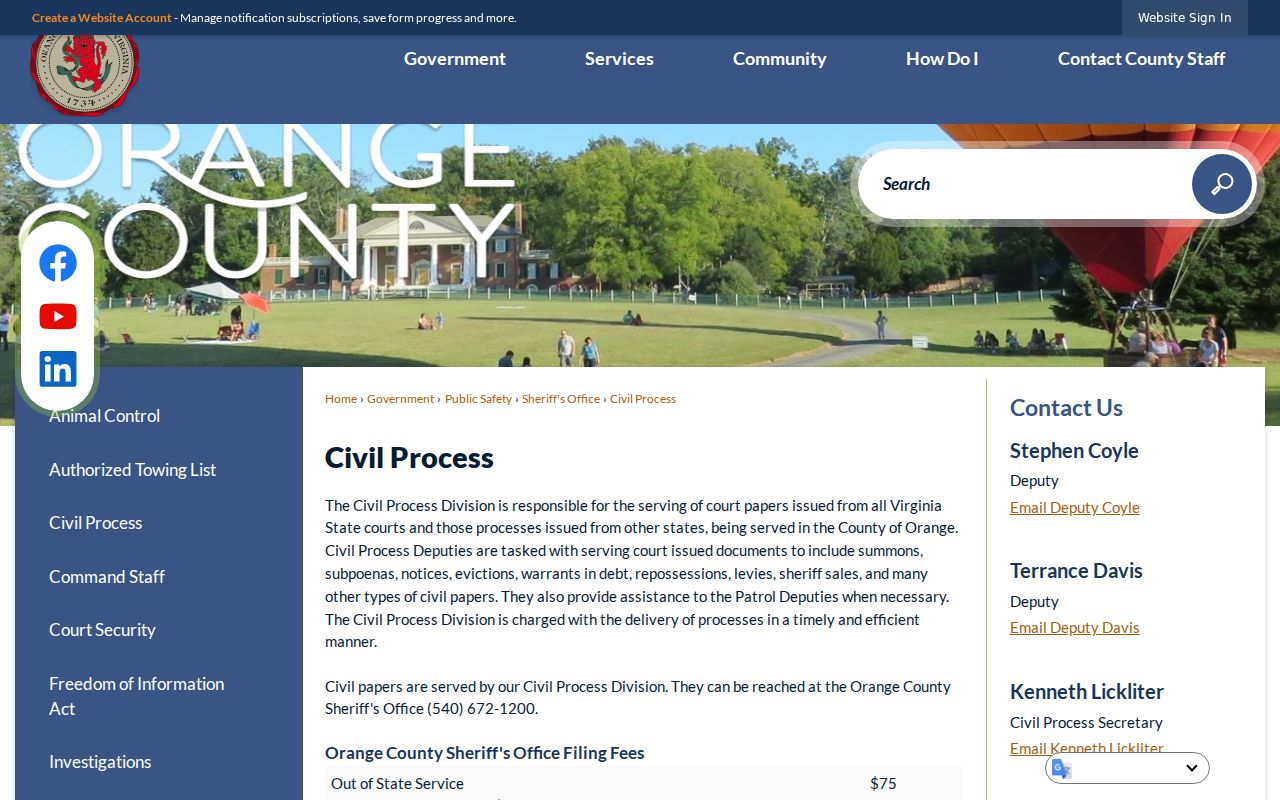
A “warrant in debt” is civil process, not a criminal arrest warrant. That distinction prevents a civil court reference from being misread as arrest history.
Dismissed Orange County Arrest Records
A dismissal updates the court outcome but does not erase every record created at arrest or booking. Compare the certified disposition with the agency report and CCRE response. If CCRE shows the wrong result, Virginia Code §9.1-132 provides a subject inspection and challenge route. A source agency may also need a copy of the court disposition so its own file can be checked.
Traditional Virginia expungement mainly covers qualifying acquittals and dismissals under §19.2-392.2. Virginia also has a separate sealing system. The current form, eligibility rule, and local filing practice should be confirmed with the Orange Circuit Clerk because major statutory changes scheduled for December 1, 2026, were not yet effective on the research date. An absent online result alone does not prove that an Orange County arrest was sealed.
Note: Correcting a wrong disposition and seeking expungement or sealing are distinct processes with different proof and filing steps.
Arrests vs Convictions
Orange County arrest records show that an agency took enforcement action or a jail completed intake. A conviction is a court judgment of guilt. Because these events come from different custodians and different stages, the terms cannot be swapped. The CCRE may link reportable arrest cycles to later dispositions, but an agency report, jail entry, court docket, and repository response still answer different questions.
| Point | Arrest record | Conviction record |
|---|---|---|
| Creator | Arresting agency and, for custody, the regional jail | Orange General District or Circuit Court |
| What it shows | An arrest, summons, or booking based on an allegation | A judicial finding of guilt on a filed charge |
| Where to verify | Originating agency, CVRJ, and related initial court event | Court clerk, certified disposition, and CCRE when applicable |
| Possible outcome | Release, no filed charge, amendment, dismissal, or later prosecution | Sentence, appeal, correction, or qualifying sealing relief |
Key distinction: An arrest is not proof of guilt. Use the Orange court disposition before describing an allegation as a conviction.
Note: A booking entry proves custody at intake, while only the court record can establish the final result of the charge.