
Criminal Cases in the Orange County Courts
Orange County criminal cases sit in three court offices at one address, but each office keeps a different file. Orange Circuit Court, part of Virginia's 16th Judicial Circuit, tries felonies after indictment and hears appeals from district courts. Orange General District Court handles misdemeanors, traffic matters, arraignments, and preliminary felony proceedings. Juvenile and Domestic Relations District Court handles juvenile delinquency and offenses against juveniles. Its confidential case details are not part of the public online search. The Commonwealth's Attorney prosecutes criminal matters in all three courts.
The official Orange Circuit Court directory confirms the local court and its public schedule.
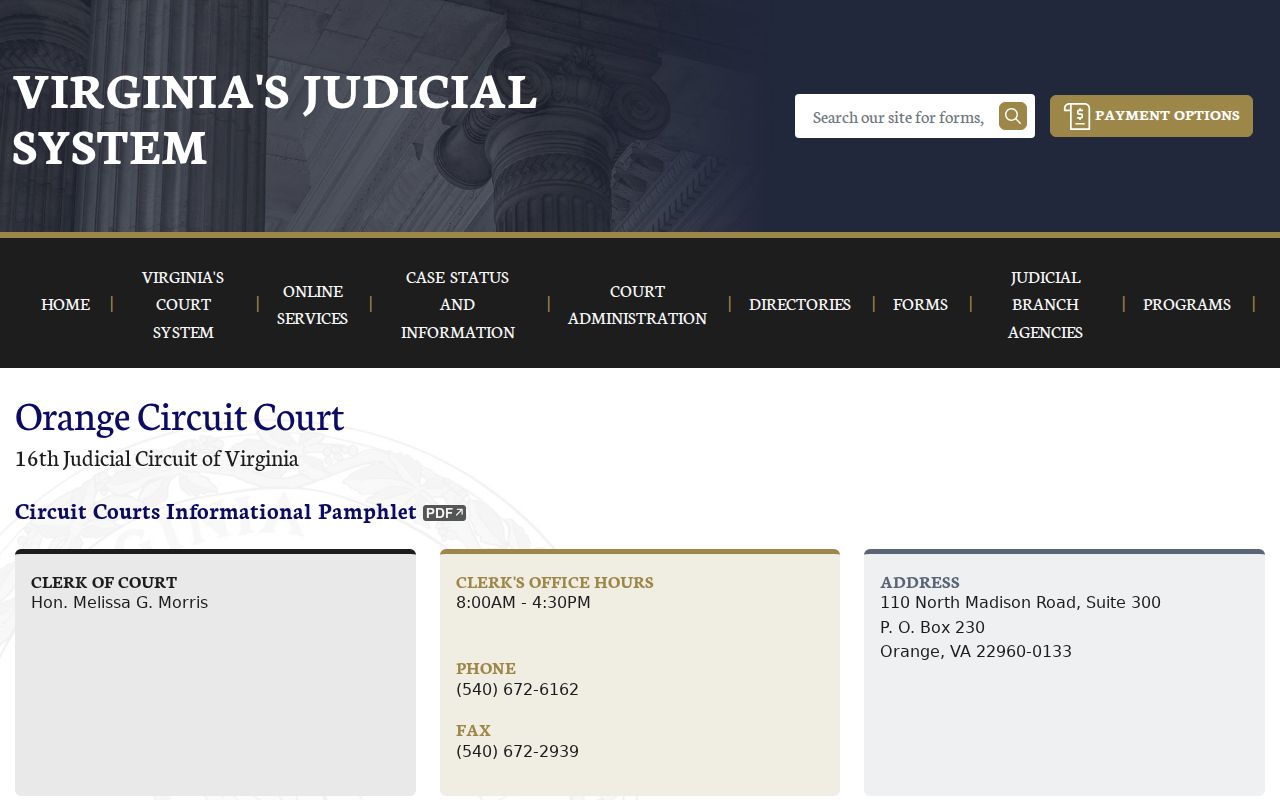
That directory helps a searcher confirm the court before calling for an Orange County case file.
| Court | Criminal role | Clerk contact |
|---|---|---|
| Orange Circuit | Felony trial, grand jury, district appeals | Suite 300; (540) 672-6162; 8:00 a.m. to 4:30 p.m. |
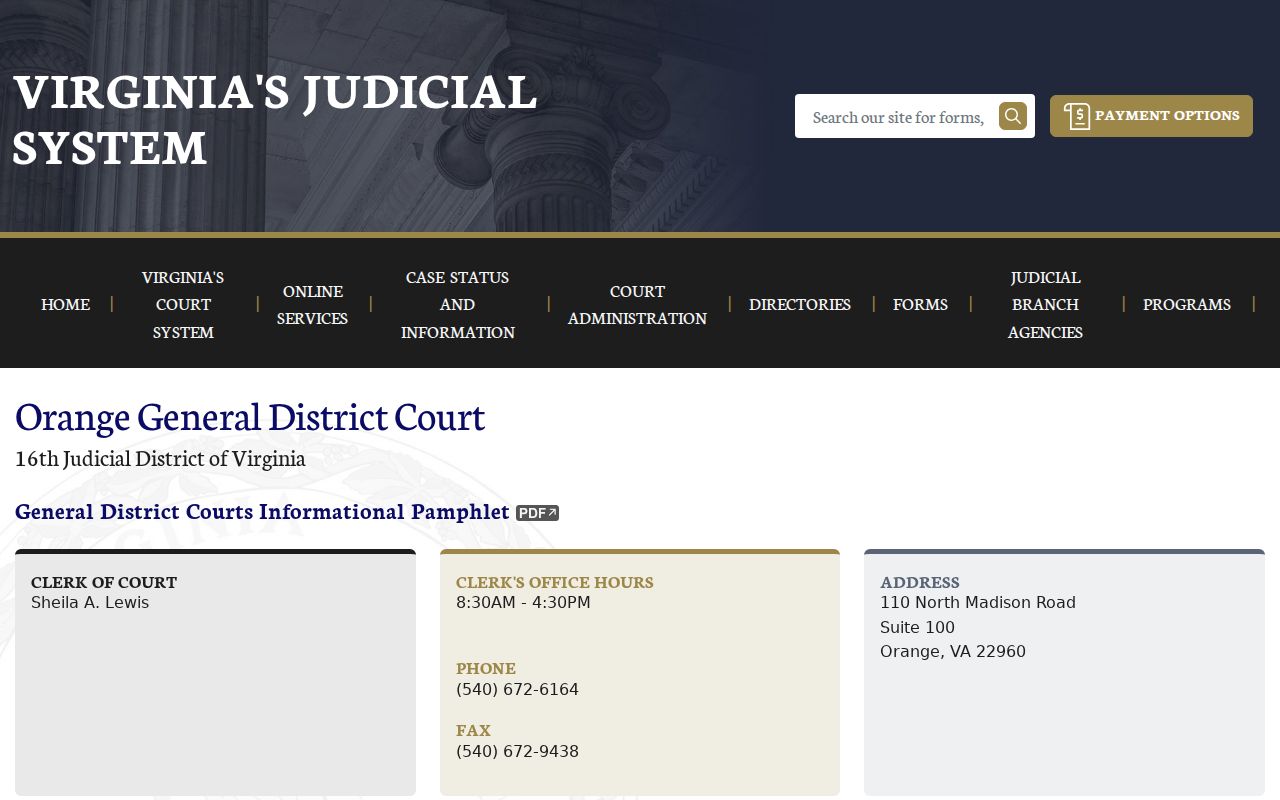
| Orange General District | Misdemeanors, traffic, arraignment, felony preliminary work | Suite 100; (540) 672-6164; 8:30 a.m. to 4:30 p.m. |
| Orange J&DR | Confidential juvenile and related jurisdiction | Suite 200; (540) 661-5320; 8:30 a.m. to 4:30 p.m. |
Orange County Court Clerk Choice
Suite 100 or Suite 300 is a practical Orange County court-record question. Start with General District when the event is a misdemeanor, traffic charge, arraignment, or preliminary felony hearing. Move to Circuit when a grand jury has returned an indictment, a felony trial is pending, or a district judgment was appealed. A felony can therefore produce entries in both systems. The district result may document only a preliminary phase, not the final Circuit disposition.
Both clerks are at 110 North Madison Road, Orange, Virginia 22960. The Circuit Clerk also receives mail at PO Box 230, Orange, VA 22960. Its local page lists cash, check, Visa, and MasterCard for court payments. A card payment of $50 or less carries a $2 service fee, while a larger card payment carries a four percent service fee. Those are payment charges, not researched copy fees. No Orange County copy price was verified, so ask the proper clerk before ordering.
The county Circuit Court clerk page is the local source for counter rules and payment details.

Its local instructions matter when an Orange County docket search must become a document or certified-copy request.
How to Search Case Records
Virginia provides separate online routes for Orange County court cases. Use General District Court Case Information for misdemeanor, traffic, arraignment, and preliminary felony events. Use the Virginia Judiciary Online Case Information System, called OCIS 2.0, for participating Circuit Court records. The judiciary warns that Virginia does not have one complete statewide Circuit search. An empty screen can mean the wrong court, older material, limited portal coverage, a name variation, or a confidential record. It does not prove that no Orange County case exists.
- Decide whether General District or Circuit most likely handled the Orange County criminal case.
- Open the matching official portal and select Orange as the court or locality.
- Use the available name, case-number, or hearing-date route. A case number is the cleanest match when known.
- Read charge, status, hearing entries, and disposition as separate fields. Check identity without publishing private identifiers.
- Call the relevant clerk for an older file, a missing docket, a certified copy, or a document that cannot be downloaded.
The General District Court search is the official district route.
It separates district-level events from the later felony file that may appear in Circuit Court.
| Portal | Search controls | Selection | Limit |
|---|---|---|---|
| OCIS Circuit | Locality, name, case number, or hearing-date routes | Select Orange | Participating Circuit data; not a complete statewide index |
| General District | Court/locality, name, case, or hearing routes | Choose Orange General District | Criminal and traffic docket data; juvenile details excluded |
Orange County Circuit Search Limits
OCIS is useful, but its boundaries shape every Orange County criminal case search. Circuit participation and available years are not the same as a single statewide master docket. Dynamic portal pages also change. The research did not support claims about exact attachment access or every live field. Searchers should use what the current screen offers, then treat the clerk's maintained file as the source when a docket is absent or incomplete.
The OCIS 2.0 landing page supplies the Circuit search route.
Choosing Orange and the right search path reduces false negatives, but clerk verification remains vital. The Virginia judiciary's Find a Case guidance explains why online coverage varies among courts.
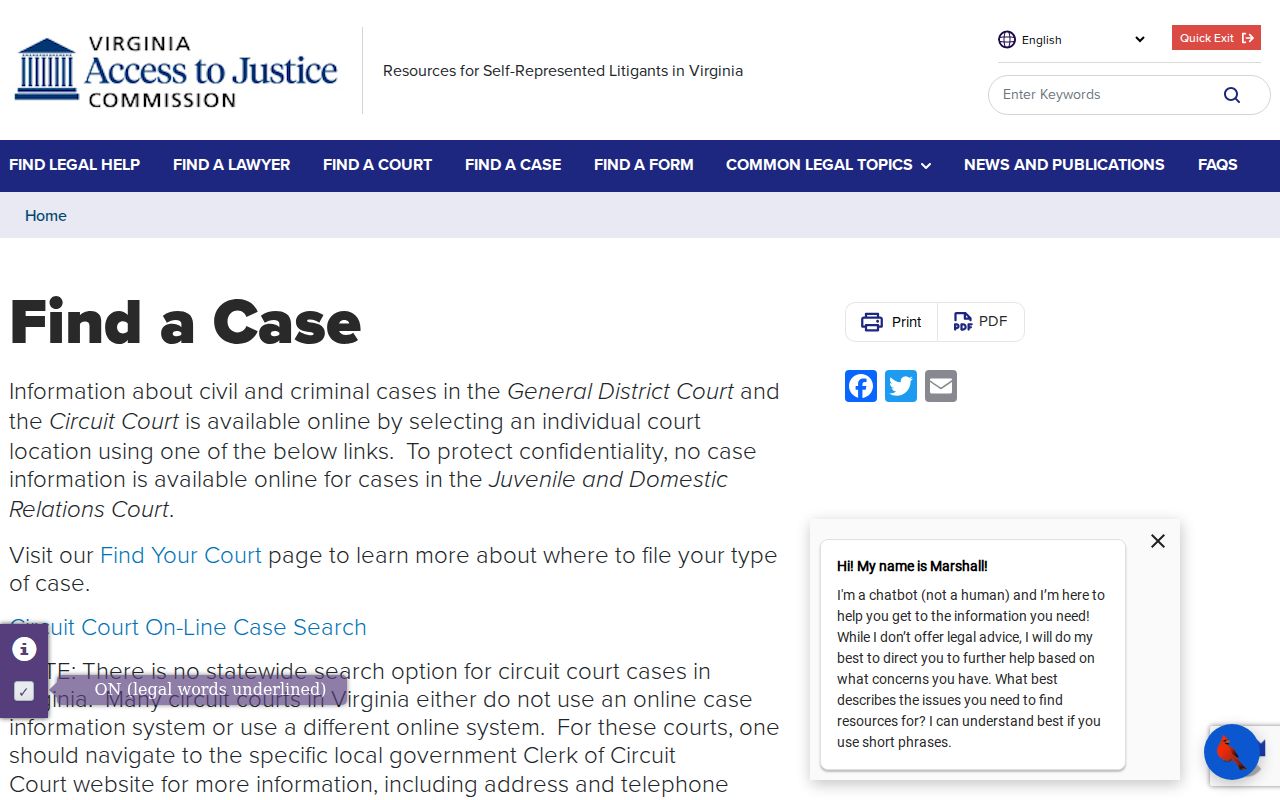
That limitation is why a no-result screen should lead to the Orange County clerk, not a firm conclusion.
What the Case File Shows
An Orange County criminal court file is built around the prosecution and the judicial result. A public docket commonly shows the case number, locality, court, charge, hearing date, status, disposition, and financial entries. The maintained file may add the complaint or indictment, motions, hearing orders, plea or judgment, sentencing order, probation terms, and appeal entries. Online data may be only an index to that fuller record. Ask for the actual file when the text of an order or motion matters.
| Case Number & Court | Identifies the Orange County file and the clerk that maintains it. |
|---|---|
| Charging Document | Shows the complaint or indictment and the charge brought before the court. |
| Docket Entries | Lists court events in date order, including motions, hearings, and orders. |
| Hearing Dates | Records scheduled and completed appearances, subject to later changes. |
| Disposition & Judgment | States how the charge ended and whether the court entered guilt. |
| Sentence & Conditions | Records punishment, probation terms, restitution, or other court orders after conviction. |
Do not substitute an arrest report for these judicial records. The sheriff's report concerns the reported event; the court file tracks the charge as prosecuted.
Orange County Criminal Court Calendar
Published court times help readers place an Orange County docket entry in context. General District lists arraignments at 8:30 a.m. Traffic and criminal calendars run on the first through fourth Wednesdays and Fridays at 9:30 a.m. It also lists OAR matters on the first Wednesday at 9:00 a.m. and VASAP matters on the second Friday at 9:00 a.m. A posted calendar is not proof that a specific case remains set. Confirm the current event through the docket or clerk.
The Orange General District directory carries the court's current published schedule.
The schedule also shows why a district docket entry may precede a later felony appearance in Circuit.
Stages of a Criminal Case
An Orange County felony may begin with an arrest or summons, followed by a magistrate or initial appearance and a bail decision. General District handles the complaint and preliminary proceeding. If a grand jury returns an indictment, Circuit Court takes the felony case for arraignment, pretrial motions, plea or trial, judgment, sentence, and any later appeal. A misdemeanor usually stays in General District unless appealed. Each step can create a new docket entry or order.
Case flow: Charges Filed › Arraignment › Pretrial › Plea or Trial › Disposition › Sentencing
Orange Circuit terms begin on the fourth Monday in January, March, May, July, September, and November. Grand juries meet on the first day of term, and court convenes at 9:30 a.m. Those dates help explain the gap between a preliminary district event and a Circuit indictment, but they do not set a guaranteed timeline for one case.
Orange County Case Outcomes
Outcome terms prevent a common Orange County record error. A disposition is the result of a charge. Nolle prosequi means the prosecution stopped that charge at that time; it is not an acquittal. A dismissal ends the charge in that case, but it does not erase the arrest by itself. An acquittal is a not-guilty result. A conviction is the court's guilt judgment, while the sentence states the punishment or terms imposed afterward.
- Pending
- The Orange County case remains unresolved. It is not a finding of guilt.
- Indictment
- A grand jury accusation that moves a felony into Circuit Court.
- Disposition
- The result entered for a specific charge.
- Nolle prosequi
- A prosecution discontinued without an acquittal.
- Sentence
- The court's penalty or supervision order after a conviction.
Read each charge line on its own. One case can contain more than one charge and more than one outcome.
Access & Restrictions
Virginia court access does not make every Orange County criminal record public. Juvenile histories are tightly restricted, and J&DR details are excluded from the public online case search. Victim and minor identifiers, Social Security or financial numbers, sealed material, and protected details may be withheld or redacted. Virginia Freedom of Information Act rules govern existing public records, while separate court rules and statutes control judicial files and criminal-history dissemination.
Virginia FOIA establishes access to existing public records subject to exemptions. Virginia Code §19.2-389.1 tightly limits juvenile-history dissemination. Neither law turns the online docket into a complete rap sheet. The clerk may provide a releasable paper or certified record when the public portal does not display it.
For a broad view across court, arrest, and repository records, use the Orange County criminal history overview. Keep each source's role clear.
Orange County Court File Pickup
A visit for Orange County criminal case records requires the correct clerk and a little planning. General District is in Suite 100, J&DR in Suite 200, and Circuit in Suite 300. The county warns that parking is limited and advises early arrival. Weapons, including pocketknives, and cell phones are prohibited. Orange County Sheriff's Office Court Security screens people and parcels, guards courtrooms, transports prisoners, and takes custody when a judge orders remand.
Clerk staff may supply records, explain copy procedures, and identify the maintained file. They cannot give legal advice. The Circuit Clerk also cannot notarize a citizen's documents. State the court, case number when known, names, and the specific order or docket material sought. That focused request is more useful than asking the sheriff for a court file, because the court clerk is its custodian.